
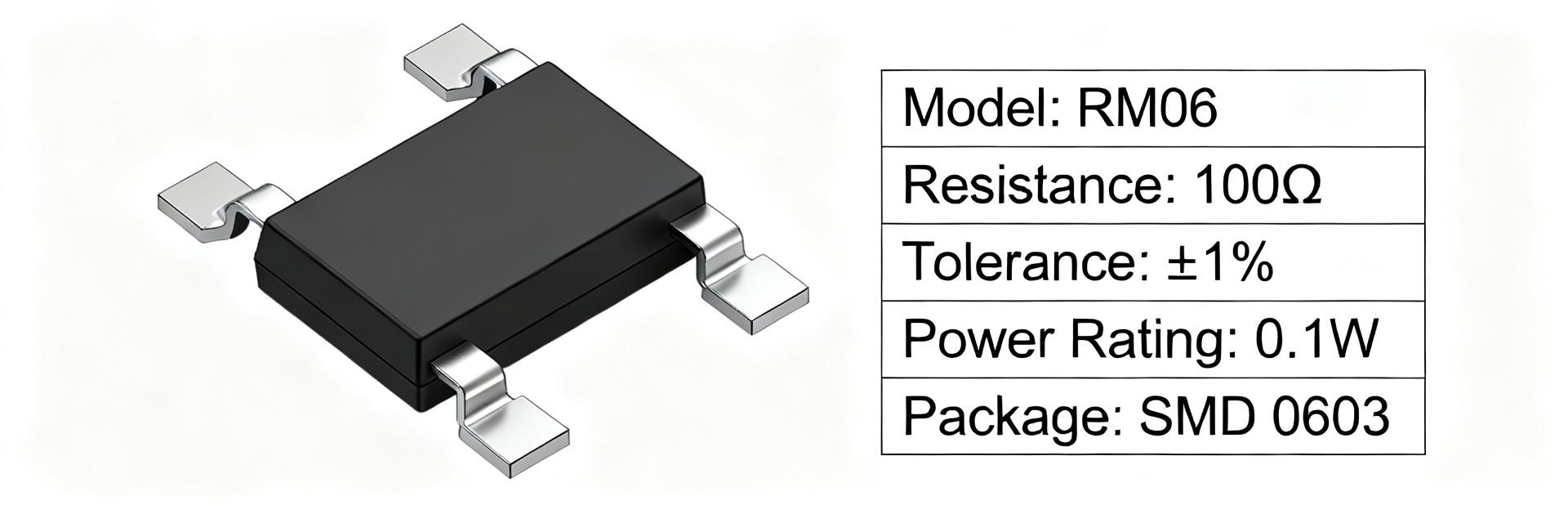
Engineers and procurement teams assessing a component need concise, data-driven intelligence: current availability signals, typical lead-time ranges for niche SMD parts, and clear interpretation of the official datasheet. This report condenses the RM06F8873CT datasheet into a compact spec snapshot, explains electrical and thermal limits, summarizes stock signals and price risk, and provides sourcing and substitution guidance. Readers will get a copy-ready spec table, key qualification checks, procurement query templates, and concrete next steps to move from sample to production with minimal delay.
1 — Background & Quick Spec Snapshot

1.1 Key electrical & mechanical specs to highlight
Point: The most relevant headline specs for board-level decision-making are nominal resistance, tolerance, power rating, package footprint, max working voltage, temperature coefficient (TCR), termination type and marking. Evidence: The official datasheet lists these parameters under the electrical/mechanical tables. Explanation: The compact table below captures the fields designers will paste into a BOM and use for footprint verification.
| Parameter | Typical Value / Range |
|---|---|
| Nominal resistance | Example: 10 Ω – 10 MΩ (per part code) |
| Tolerance | ±0.1% to ±5% (depending on code) |
| Power rating | 125 mW (0603-equivalent thermal environment) |
| Package footprint | RM06 (0603-equivalent) |
| Max working voltage | Up to 50 V (varies by resistance) |
| Temperature coefficient (TCR) | ±25 ppm/°C typical (select grades) |
| Termination type | Matte/Sn-plated terminations |
| Marking / code | Standard SMD numeric or band codes |
Design implications: 1) Thermal limits dictate copper area and spacing—power dissipation must be derated on small pads. 2) High-precision grades require careful assembly and ESD handling to preserve TCR and tolerance.
1.2 Typical applications & what those specs mean in practice
Point: Typical use cases include signal path resistors, pull-ups/pull-downs, sensing networks, and precision dividers. Evidence: Tolerance and TCR drive suitability for high-accuracy sensing versus general-purpose circuitry. Explanation: For sensing, choose tighter tolerance and low TCR; for pull-ups, higher tolerance and standard power rating suffice. As a rule of thumb, derate power rating by 50% for continuous operation in constrained copper areas and place high-precision parts away from heat sources and large thermal vias.
2 — Datasheet Deep-Dive: How to Read & Interpret
2.1 Electrical characteristics explained
Point: Datasheet electrical tables specify nominal resistance, tolerance bands, test conditions, maximum dissipation, and noise characteristics. Evidence: Nominal values are typically measured at 25°C with specified test currents; maximum dissipation assumes a defined PCB copper area. Explanation: When reading a datasheet, confirm the test ambient, power dissipation basis (junction vs. ambient), and whether tolerance is guaranteed across temperature. Red flags include unspecified test conditions, ambiguous end-of-life limits, or missing temperature coefficients for precision grades.
2.2 Thermal, mechanical and reliability data
Point: Thermal derating curves, reflow profiles and mechanical test results determine assembly and qualification risk. Evidence: The datasheet presents soldering profile windows, thermal resistance figures, and cycle limits for humidity and shock. Explanation: Use the derating curve to set a safe continuous dissipation percentage (commonly 50–70% of rated power for surface-mount on minimal copper). Verify reflow peak temperatures and time-above-liquidus for your process; plan shock/vibration qualification if the end product is mechanically demanding.
3 — Stock & Availability Analysis for RM06F8873CT
3.1 Current stock signals & lead-time trends
Point: Stock signals combine inventory snapshots, lead-time feeds and backorder flags to indicate procurement risk. Evidence: "In-stock" listings with small quantities differ substantially from multi-week available-to-ship dates; sustained backorder flags often precede price jumps. Explanation: For a specialized SMD like RM06F8873CT, interpret availability tiers as project triggers: OK (≥12 weeks of cover), Limited (2–4 weeks left), Backorder (>4 weeks lead). The table below converts observed signals into actionable tiers to guide ordering urgency.
| Availability Tier | Typical Signal |
|---|---|
| OK | Multiple suppliers, ≥4 weeks inventory |
| Limited | Low qty per source, short leads |
| Backorder | Long lead-times, allocated stock |
3.2 Price trends, minimum order quantities (MOQs) & cost risk
Point: Price and MOQ behavior affects prototype vs. production economics. Evidence: When available supply tightens, unit prices and minimum reel buys often increase; landed cost grows with expedited freight and small-batch premiums. Explanation: Set cost thresholds (e.g., unit cost increase >15% or MOQ forcing >10x prototype needs) as triggers to evaluate alternates or negotiate contract terms. Track historical fulfillment rates and prioritize components with stable multi-source pricing for production BOMs.
4 — Sourcing & Substitution Guide
4.1 Procurement checklist for ordering RM06F8873CT
Point: A brief procurement checklist prevents common ordering errors. Evidence: Mismatches in marking, reel type, or moisture-sensitivity packing cause assembly delays. Explanation: Verify part marking, reel orientation, exact footprint code, tolerance and TCR grade, packaging (cut tape vs. full reel), shelf-life, humidity-pack needs, and request certificate of conformity. Use the following template lines when querying a supplier: part code / lot code / reel size / packing date / RoHS & C of C / lead time / cancellation terms.
4.2 How to find and validate substitutes or equivalents
Point: Equivalence requires careful matching of footprint, tolerance/power/TCR, terminations and soldering profile. Evidence: Cross-referenced parts may share a code but differ in finish or process, which affects reliability. Explanation: Define equivalence criteria explicitly, procure samples from each candidate, perform sample builds, run tolerance drift checks and accelerated aging, and document acceptance criteria before approving alternates for production.
5 — Practical Recommendations & Next Steps
5.1 For design engineers: testing & BOM updates
Point: Engineering actions reduce risk and speed qualification. Evidence: Documented derating and test points catch thermal and tolerance issues during validation. Explanation: Apply a conservative derating percentage (50–70%), add PCB test pads near precision resistors, and include approved alternates in the BOM with explicit electrical and thermal equivalence notes. Add assembly notes for soldering limits and ESD handling to the design pack.
5.2 For procurement & supply chain: ordering strategies
Point: Order strategy mitigates lead-time and price volatility. Evidence: Staggered orders, safety-stock policies, and sample-to-production ratios help bridge supply gaps. Explanation: Recommended tactics: maintain 8–12 weeks safety stock for constrained parts, stagger orders to avoid obsolescence, use sample-to-production ratios of at least 1:20 for initial runs, and set clear triggers for requalification when a substitute is used. Decision tree: in-stock → buy; limited & long lead → evaluate substitutes/prepay; out-of-stock → redesign or requalify alternative.
Summary
One-line recap: The RM06F8873CT is a small-footprint SMD resistor family offering a range of resistances, tolerances and TCR options suitable for precision sensing and general-purpose applications; thermal derating and correct footprint verification are essential. Current stock outlook: availability tiers range from OK to Backorder—monitor inventory feeds and set procurement triggers when cover falls below target weeks. Immediate actions: verify datasheet thermal limits during layout and secure a qualifying sample plus a short production order to lock price and lead-time. The bullets below highlight the top priorities.
- Confirm exact resistance/tolerance/TCR grade and footprint before placing any reel order; improper selection causes late rework and scrap.
- Monitor stock signals daily; if availability drops to Limited, initiate alternate qualification and increase safety stock to 8–12 weeks.
- Run a defined validation: sample build, tolerance drift check, and accelerated aging to approve any substitute for production use.
FAQ — Common Questions
What is the typical power rating and package for RM06F8873CT?
The RM06F8873CT family is commonly supplied in an RM06 (0603-equivalent) footprint with typical power ratings around 125 mW on a standard PCB footprint. Designers must derate continuous dissipation based on copper area and ambient conditions; verify the datasheet reflow and thermal resistance notes before finalizing placement.
How should teams interpret stock signals for small SMD parts?
Interpret signals as tiers: OK when multiple authorized sources show several weeks of inventory; Limited when quantities and lead-times shrink; Backorder when allocation or long leads appear. Use these tiers to trigger procurement actions—accelerate buys, qualify alternates, or plan design adjustments depending on project timelines.
What validation steps are recommended for substitutes?
Validate substitutes with sample builds, tolerance drift testing across temperature cycles, solderability and reflow profile compatibility checks, and an accelerated aging test. Document test results against acceptance criteria before updating the approved parts list to avoid field failures.
What critical parameters must be checked before placing a bulk RM06F8873CT order?
Always verify exact nominal resistance, tolerance grade, temperature coefficient (TCR), packaging format (cut tape vs. full reel), moisture sensitivity level (MSL), and complete environmental compliance certifications (RoHS/REACH) before confirming bulk orders.